
Adult day care attendance sheet template
What a good sign-in sheet captures, why it matters for billing and monitoring visits, and a free template you can print or open in a spreadsheet.
Last reviewed 5 min read
The attendance sheet looks like the simplest paper in the building. It is also the one that ties everything together. It shows who was in your care, when they arrived and left, and what services they got. When it's filled in well, month end is quick. When it isn't, someone spends an afternoon piecing together who was there on the 14th.
Below is what a good sheet captures, and a free template you can print or open in a spreadsheet.
Why the sheet matters
- It is the record behind your billing. If a county DSS pays you per day of service, each unit on your invoice should trace back to a mark on this sheet. Our guide to billing DSS in North Carolina covers that side.
- It shows you stayed within your limits. In North Carolina, daily attendance can't go over your certified capacity, and staff ratios are based on who is actually there, according to the state's adult day procedures manual.
- It gets looked at. The same manual lists participant attendance sheets among the records a reviewer checks when looking into a concern about a particular day.
- It answers questions from families. What time did Mom get here? Did Dad eat lunch? The sheet has the answer.
What to record each day
A daily sign-in sheet has one line per participant. These are the columns worth having.
| Column | What to write | Why |
|---|---|---|
| Date and center | At the top of every page | Loose pages get mixed up |
| Participant | Full name as it appears in their file | Matches your billing and enrollment records |
| Arrival time | The time they came in, plus staff initials | Shows when your care began |
| Departure time | The time they left, plus staff initials | Shows when your care ended |
| Present or absent | P or A, with a short reason for an absence | Your contract may ask you to report absences |
| Meals | Breakfast, lunch, snack | Shows the meal and snacks were served |
| Transportation | No ride, one way, or round trip | Rides may be billed separately |
| Picked up by | Name and signature of the person taking them home | Confirms a safe handoff |
| Notes | Left early, trial visit, center closed | Explains anything unusual |
Keep the reason for an absence short, like "ill" or "family trip". If someone is out several days in a row, your county contract may ask you to let DSS know, so the note helps you spot it.
The monthly attendance grid
Daily sheets are good for the front desk. For billing, it helps to roll them up into one grid per month: a row per participant and a column for each day. At month end you add across each row and down each column.
A simple key keeps the grid readable:
- P for present and A for absent.
- C for a day the center was closed, such as a holiday or weather closing.
- Add 1 for a one-way ride or 2 for a round trip, so P2 means present with a round trip.
Totals at the end of each row give you days present, days absent, one-way rides and round trips. Those numbers feed straight into the invoice.
Download the template
The template is free. No sign-up. It has a monthly grid with room for 25 participants, plus a daily sign-in page on the printable version. It uses no real names.
The CSV opens in Excel, Google Sheets or Numbers. The printable version is set up for landscape letter paper.
Keeping it clean
A sheet only helps if everyone fills it in the same way. Decide who owns it on each shift, usually the person at the front door in the morning and whoever sees people off in the afternoon. Keep a pen and the sheet in one spot so it never wanders off. Then walk new staff through it on their first day, the same way you would the fire drill route.
- Fill it in as people arrive, not at the end of the day. Times written from memory are guesses.
- Use pen, and fix mistakes with a single line. Initial the change so anyone reading it knows who made it.
- Mark closed days for everyone. A blank can look like a missing record.
- Don't count trial visits. A visit before enrollment is not a day of attendance.
- Total the month and have someone check it. Compare the grid with the daily sheets before you build the invoice.
- File it with the invoice. Keep each month's sheets with the invoice they support, in a locked place, since they name your participants.
Replacing the paper sheet
Paper works. It just means counting by hand and keeping the pages safe. In Senior Care Connected, the Participants screen does the job of the sign-in sheet.
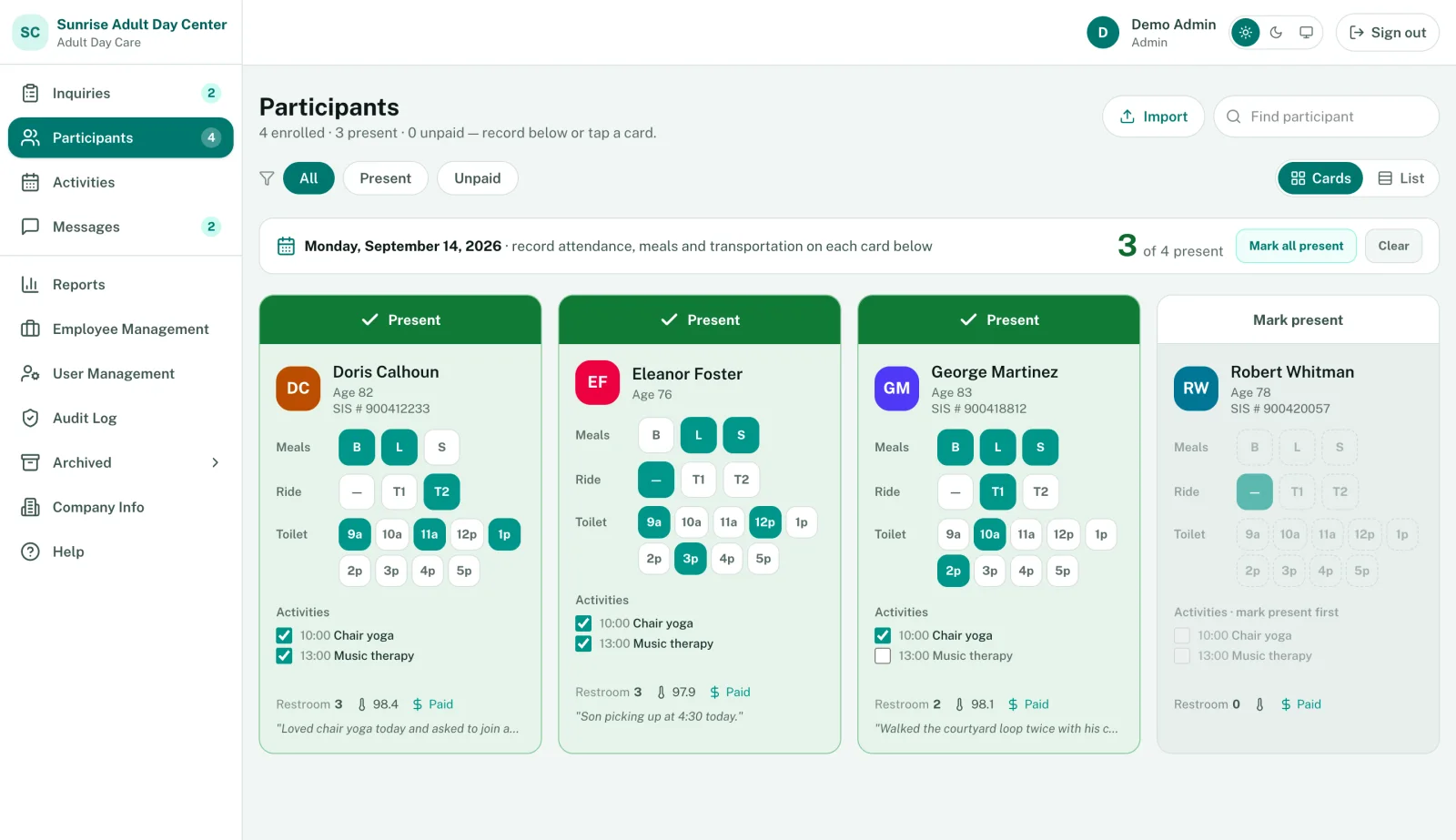
- Staff tap the top of a participant's card to mark them present. The count at the top goes up as people arrive.
- Breakfast, lunch and snack, and T1 or T2 rides, are one tap each on the same card.
- Attendance history and absences are kept for you.
- Monthly attendance, meals and transportation reports print under your center's name, with no totals to add up.
- If you bill DSS, each attended day becomes a unit on your monthly DSS invoice.
This article is general information, not billing or legal advice. Check current requirements with your county DSS and NC DHHS. Last reviewed .